Structurally larger deficits are changing gold from a tactical hedge into a strategic allocation
After declining 30% from the peak earlier this year, gold price has staged a strong recovery of late – rising over 10% from the low. Gold’s resurgence is often explained by geopolitical concerns and inflation fears. Those forces still matter, but the most durable support for gold today may come from the rising concerns on fiscal sustainability across developed-market governments. Ageing populations, defence commitments, industrial policy and higher interest costs are making large fiscal deficits increasingly structural rather than cyclical. As investors question whether governments can stabilize debt without higher taxes, lower spending, faster growth or some erosion in the real value of their liabilities, gold is regaining relevance as monetary insurance.
In the U.S, the Congressional Budget Office (CBO) projects a federal deficit of 5.8% of GDP in 2026, widening to 6.7% by 2036, while debt held by the public rises from 101% to 120% of GDP. The policy rate cut done in the past three years has failed to bring yields at the long end of the curve lower as investors demand higher risk premium for investing in longer-term maturities. Indeed, fiscal outlook across the world is worrisome (Figure 1).
Figure 1. Fiscal deficit is here to stay across major countries
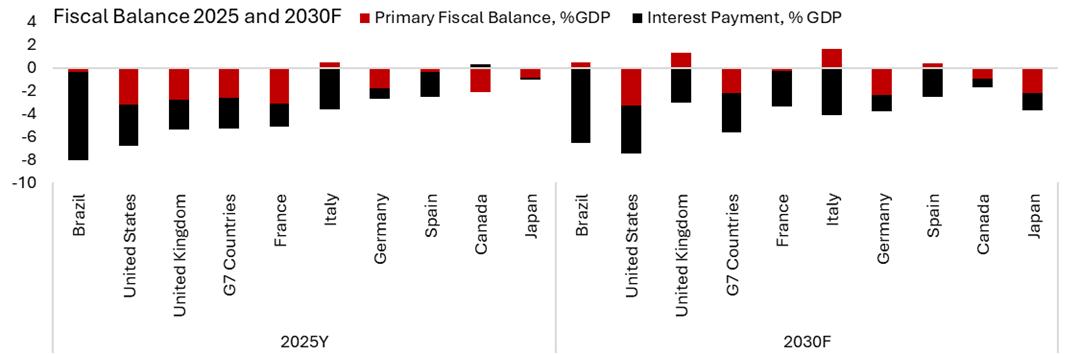
Those deficits are also increasingly contributed by rising government borrowing costs. This creates an unfavourable feedback loop, not only for the U.S. government, but also other developed countries: higher debt requires more issuance, which could translate to higher term premiums and further raise the cost of servicing that debt.
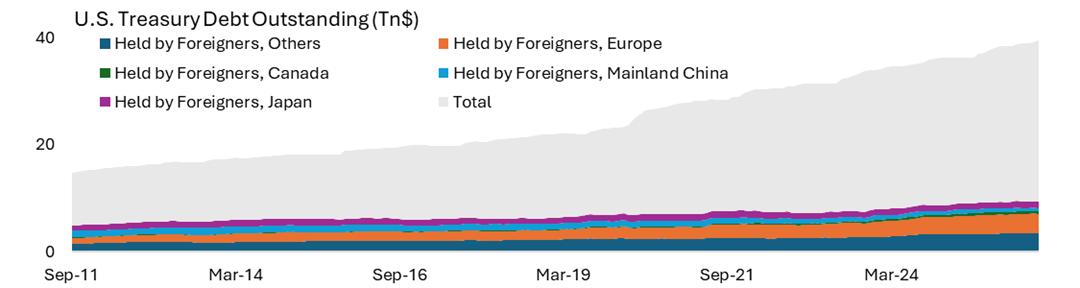
Markets do not need to anticipate default for fiscal sustainability to matter. A gradual loss of confidence can appear through a higher term premium, a weaker currency, greater demand for inflation protection and a reduced willingness by foreign reserve managers to absorb sovereign issuance at prevailing yields (Figure 2). The freezing of Russian foreign reserve assets following the Ukraine invasion also changed the calculus of both developed and emerging countries’ central banks for holding treasuries. This means the rise in U.S. government debt will increasingly be met by price-sensitive buyers, translating to a higher risk premium and making it more expensive for U.S. government to borrow.
Figure 2. U.S. treasury issuance is outpacing foreigners’ appetite to hold them
Social spending rises as populations age, defence budgets are being rebuilt, and governments are subsidizing strategic industries and domestic supply chains. Governments therefore face three difficult choices, each with implications for the value of their currencies:
- Fiscal consolidation through spending cuts or tax increases, which is politically difficult and can weaken near-term growth;
- Structurally higher borrowing costs as investors demand greater compensation for inflation, fiscal risk and potential currency weakness; or
- Monetary accommodation and financial repression that hold financing costs below inflation and gradually reduce the real value of government liabilities.
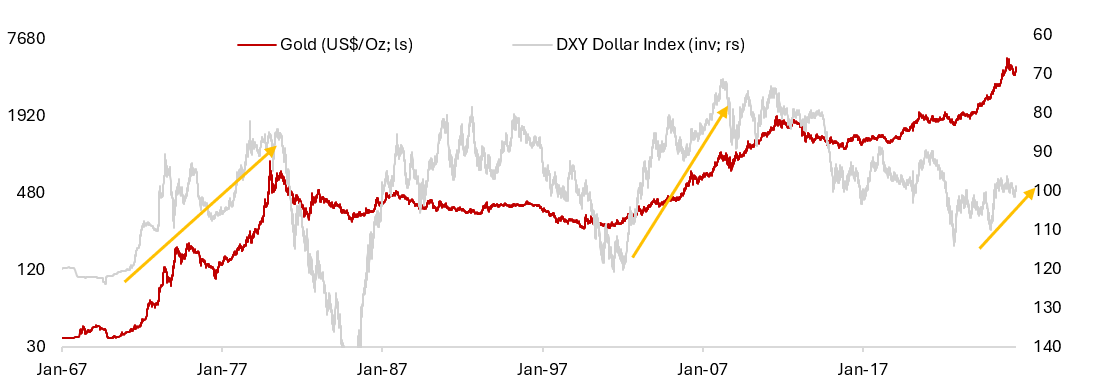
The third path amounts to currency debasement. Rather than explicitly defaulting or imposing severe austerity, governments can allow inflation, negative real interest rates and balance-sheet expansion to erode the purchasing power of money and reduce debt burdens in real terms. Gold benefits in this environment because its supply cannot be expanded by policymakers, making it a store of value when confidence in fiat currencies weakens (Figure 3).
Figure 3. Weaker dollar trend has historically been a tailwind for gold price
Gold’s New Regime
A government bond depends on the issuer’s ability and willingness to preserve its real value. A bank deposit depends on the banking system. A currency depends on confidence in the institution that issues it. Gold is unique as an asset given that it is tangible, carries no sovereign credit risk and cannot be created out of thin air. This characteristic is valuable for foreign currency reserve managers, which have been gradually increasing their gold holdings.
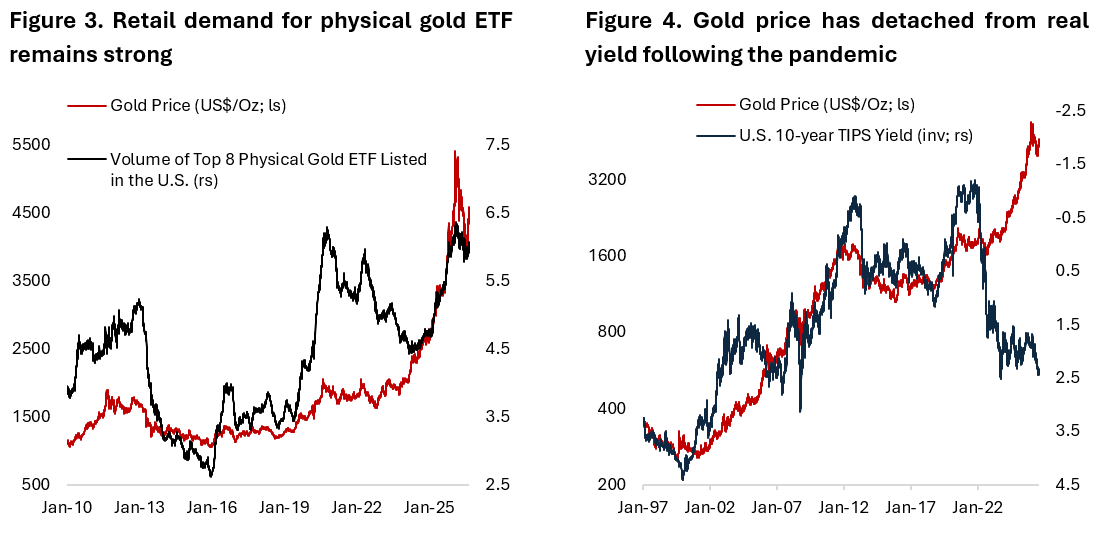
Official-sector gold purchases remained historically elevated in 2025, and the World Gold Council’s 2026 survey found that 89% of reserve managers expected global central-bank gold holdings to rise over the following year. A record 45% expected their own institutions to add gold, while 74% anticipated a lower U.S.-dollar share of global reserves over five years. Meanwhile, retail investment demand for precious metals is also trending higher (Figure 3).
This shift helps explain why gold has remained firm despite rising and elevated real yields. Traditionally, higher inflation-adjusted bond yields increase the opportunity cost of owning a non-yielding asset. But when higher real yields themselves reflect fiscal stress, heavier sovereign supply or a rising policy-risk premium, they send a second signal: nominal bonds may be offering more income because investors perceive more uncertainty around their long-term real value. Under those conditions, gold and real yields can rise together (Figure 4).
It is therefore more useful to think of gold as a hedge against policy credibility than as a simple hedge against consumer-price inflation. Gold can struggle during disinflation if real yields rise for healthy reasons, such as stronger productivity or credible fiscal reform. It can also outperform when measured inflation is moderate but investors are worried about debt monetization, currency intervention, sanctions risk or a weakening commitment to fiscal discipline.
Investment Implications
Gold prices have already start to rise and investors should expect volatility and periods of consolidation. Yet the underlying demand mix is more durable than in prior speculative episodes. Central banks are relatively insensitive to short-term price moves, exchange-traded fund participation has room to expand, and mine supply responds slowly even when prices are high. Those features can keep the market structurally tight without producing a straight-line advance.
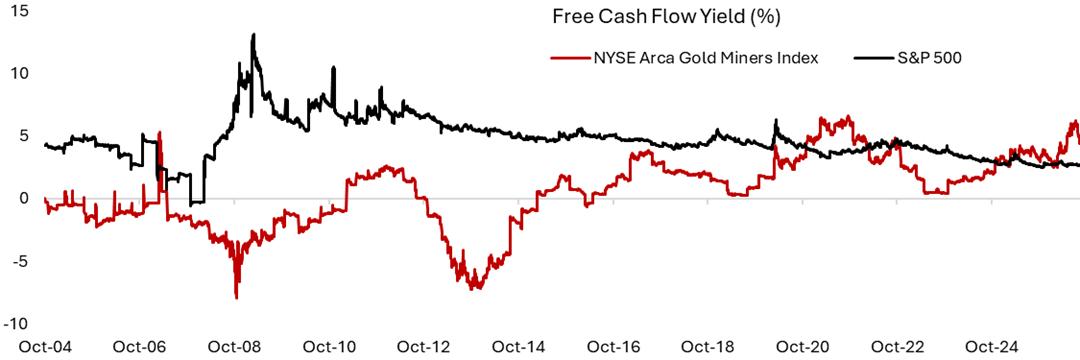
Gold miners offer a higher-beta expression of the thesis. At elevated bullion prices, revenue can rise faster than operating costs, producing stronger margins and free cash flow. But miners add equity-market, execution, jurisdictional and capital-allocation risks that physical gold does not carry. A balanced approach can therefore use bullion or physically backed exposure as the monetary hedge and miners as a smaller, return-seeking satellite position. Note that gold miners’ free cash flow yield is now higher than the S&P 500 benchmark – a period that has been historically short lived (Figure 5).
Figure 5. Gold miners’ free cash flow are now higher than the S&P 500
Copyright © 2026, Putamen Capital. All rights reserved.
The information, recommendations, analysis and research materials presented in this document are provided for information purposes only and should not be considered or used as an offer or solicitation to sell or buy financial securities or other financial instruments or products, nor to constitute any advice or recommendation with respect to such securities, financial instruments or products. The text, images and other materials contained or displayed on any Putamen Capital products, services, reports, emails or website are proprietary to Putamen Capital and should not be circulated without the expressed authorization of Putamen Capital. Any use of graphs, text or other material from this report by the recipient must acknowledge Putamen Capital as the source and requires advance authorization. Putamen Capital relies on a variety of data providers for economic and financial market information. The data used in this publication may have been obtained from a variety of sources including Bloomberg, Macrobond, CEIC, Choice, MSCI, BofA Merrill Lynch and JP Morgan. The data used, or referred to, in this report are judged to be reliable, but Putamen Capital cannot be held responsible for the accuracy of data used herein.

